AI in software engineering, grounded in real systems

I write about how agentic AI is changing software work, drawing on my experience leading engineering teams, writing code and building a coffee-roasting agent that has to stay safe around real hardware, with the Industrial Revolution providing one comparison I wanted to explore.
Latest
Verification Has a Clock · 31 Aug 2026
The cost and timing of being wrong play a key role when deciding on agent autonomy
New essays land here first: get them by email.
The series
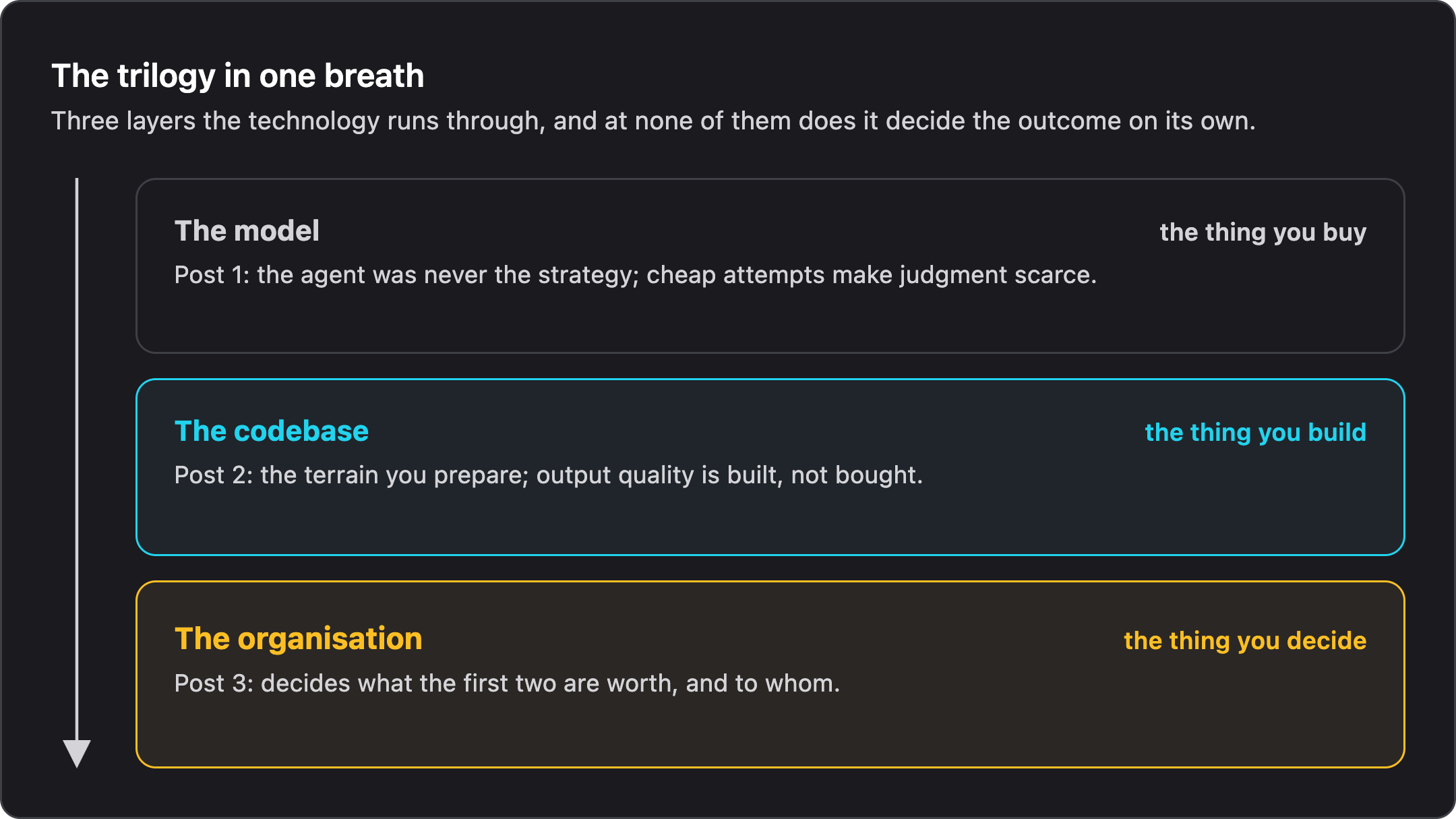
Cheap Tokens, Cheap Attempts · 7 Jun 2026
Cheap generation doesn't make engineering judgment obsolete. It makes it the scarce thing, and the first Industrial Revolution shows why.
Better Ground, Not a Better Model · 1 Jul 2026
You don't get a better agent by buying a better model alone. You get one by preparing the ground it runs on: the tests, the structure, the rules it runs inside.
The Factory Was the Real Invention · 19 Jul 2026
The factory, not the machine, was the real invention. The final post in the series: how the organisation decides what AI productivity is worth, and who it is for.
Read the series in order, or browse everything in the writing archive.
The work
Much of my writing draws on RoastPilot, an open-source coffee-roasting agent built around an audio dataset, a first-crack detection model, edge deployment on a Raspberry Pi, a Model Context Protocol (MCP) server that owns the roaster, and a deterministic safety harness around the system.
See the work, or the short version of who I am and why I write this.